 Síguenos @ContraReplicaMX
Trump descarta tropas estadounidenses pero prioriza el poder aéreo en el acuerdo con Ucrania
Global
afp
President Donald Trump on Tuesday ruled out sending US troops but envisioned extending US air power as Western nations began hashing out security guarantees for Ukraine before any potential summit with Russia.
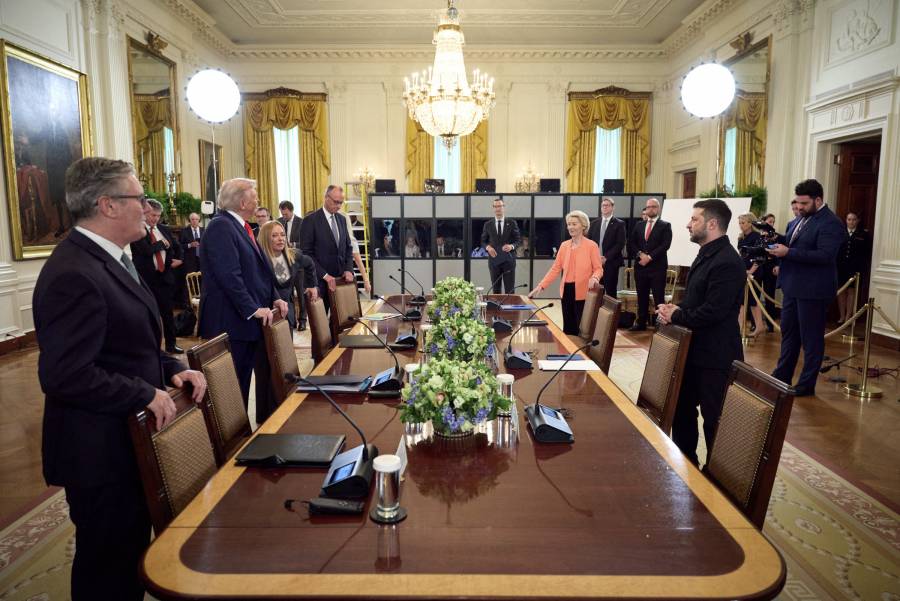
Trump, in a flurry of diplomacy aimed at ending the war, brought Ukrainian President Volodymyr Zelensky and top European leaders to the White House on Monday, three days after his landmark encounter with Russia's Vladimir Putin in Alaska.
Trump said President Putin, whom he called in the middle of Monday's talks, had agreed to meet Zelensky and to accept some form of Western security guarantees for Ukraine against Russia -- promises met with extreme caution by Kyiv and European leaders.
Putin proposed holding the summit with Zelensky in Moscow, three sources familiar with the Trump call told AFP. One source said Zelensky immediately said no to the Russian capital.
Trump, long a fierce critic of the billions of dollars in US support to Ukraine since Russia invaded in 2022, said that European nations would take the lead by sending troops to secure any settlement -- an idea that has been mulled by France and Britain.
"When it comes to security, they're willing to put people on the ground," Trump said in a Fox News interview.
"We're willing to help them with things, especially, probably, if you talk about by air, because no one has the kind of stuff we have. Really, they don't," Trump said.
He added his "assurance" that no US ground troops would deploy to Ukraine, and he again categorically ruled out Ukraine joining the Western military alliance NATO.
Trump has sided with Putin in describing Kyiv's NATO aspirations as a cause for the war, in which tens of thousands of people have died.
European leaders, Ukraine and Trump's predecessor Joe Biden called the issue a pretext and pointed to Putin's statements rejecting the historical legitimacy of Ukraine.
- Allies discuss next steps -
Following the Trump talks, French President Emmanuel Macron and British Prime Minister Keir Starmer brought together around 30 of Ukraine's allies known as the "Coalition of the Willing" for virtual consultations.
Starmer told them coalition teams and US officials would meet in the coming days to discuss security guarantees and "prepare for the deployment of a reassurance force if the hostilities ended," a Downing Street spokesperson said.
"The leaders also discussed how further pressure -- including through sanctions -- could be placed on Putin until he showed he was ready to take serious action to end his illegal invasion."
Macron, speaking to reporters before leaving Washington, also called for additional sanctions if Putin does not show a willingness for peace.
Britain's military chief, Admiral Tony Radakin, will travel to Washington on Tuesday for the talks on reassurances.
Los jefes de estado mayor militares de los 32 países miembros de la OTAN también se reunirán por video el miércoles para discutir sobre Ucrania, dijeron los funcionarios.
- Ginebra se ofrece como sede -
Rusia ha advertido que cualquier solución también debe proteger sus propios intereses.
El ministro de Asuntos Exteriores, Sergei Lavrov, declaró al canal de televisión estatal Rossiya 24 que cualquier acuerdo debe garantizar los derechos de "las personas de habla rusa que viven en Ucrania", otra cuestión citada por Moscú para la ofensiva lanzada en febrero de 2022.
Seguramente Moscú sería visto como un lugar provocador para una cumbre, con sugerencias de que equivaldría a una rendición de Ucrania.
Macron dijo al canal de noticias francés LCI que quería que la cumbre se celebrara en Ginebra, un lugar histórico para las conversaciones de paz.
El ministro de Asuntos Exteriores suizo, Ignazio Cassis, dijo que el gobierno estaría dispuesto a ofrecer inmunidad a Putin, quien enfrenta una orden de arresto de la Corte Penal Internacional relacionada con abusos en la guerra.
Macron y el canciller alemán, Friedrich Merz, dijeron que la cumbre podría tener lugar en dos semanas.
Trump también está buscando una cumbre tripartita que lo involucre, mientras que Macron ha pedido una reunión de cuatro vías que involucre a los europeos que serán vitales para la seguridad de Ucrania.
En las calles de Kiev reinaba el escepticismo sobre si las últimas conversaciones podrán poner fin al conflicto.
"El problema principal es que el propio Putin no lo quiere", dijo Anton, de 32 años, que trabaja en un almacén.
"Pueden reunirse tantas veces como quieran, pero Putin no lo necesita y Donald Trump no sabe realmente qué hacer".
Pero en Moscú, algunos se mostraron más optimistas. «Espero que podamos llegar a un acuerdo mutuamente beneficioso», dijo Vyacheslav, de 23 años, quien trabaja para el gobierno.
burs-sct/mlm
© Agencia France-Presse

Envíe un mensaje al numero 55 1140 9052 por WhatsApp con la palabra SUSCRIBIR para recibir las noticias más importantes.
SG/CR
Etiquetas
 Global
2026-09-12 - 15:08
 Global
2026-09-12 - 14:49
 Global
2026-09-11 - 19:10
 Global
2026-09-11 - 17:18
 Global
2026-09-11 - 14:01

 Global
2026-09-10 - 20:21
 Global
2026-09-10 - 20:19

 Global
2026-09-10 - 20:12
 Global
2026-09-10 - 19:30
 Global
2026-09-10 - 15:54
 Global
2026-09-10 - 15:49